

There’s something specifically about Rome that always leaves me with more and more questions. I go looking for one thing and then fall down a seemingly endless rabbit hole of “Why did they do it that way?” “How long did that take?” “Who built this and for what purpose?” “What did they think about this that led them to this conclusion?” And on and on and on. If you read my previous post, asking questions in an attempt to get to the origin story is something embedded in my DNA. I feel compelled to dive into the unseen dimensions of existence.
Ancient Rome had a festival for practically everything. For example, last week I discovered that a two-day festival called Neptunalia begins on July 23rd, right in the peak heat of summer, when water is at its scarcest all year. It sounds like it should be a beach day, but it isn’t. It's an enigma compared to other festivals, held for a god who was also worshipped as Neptune Equester, patron of horses and horsemanship, a title that has nothing obvious to do with sand or salt water at all. Now with Neptune (the planet) in retrograde, which started July 7th, it felt like this was the week to go looking for him all around the city. What ended up surprising me the most was Neptune wasn’t the god I thought he was.
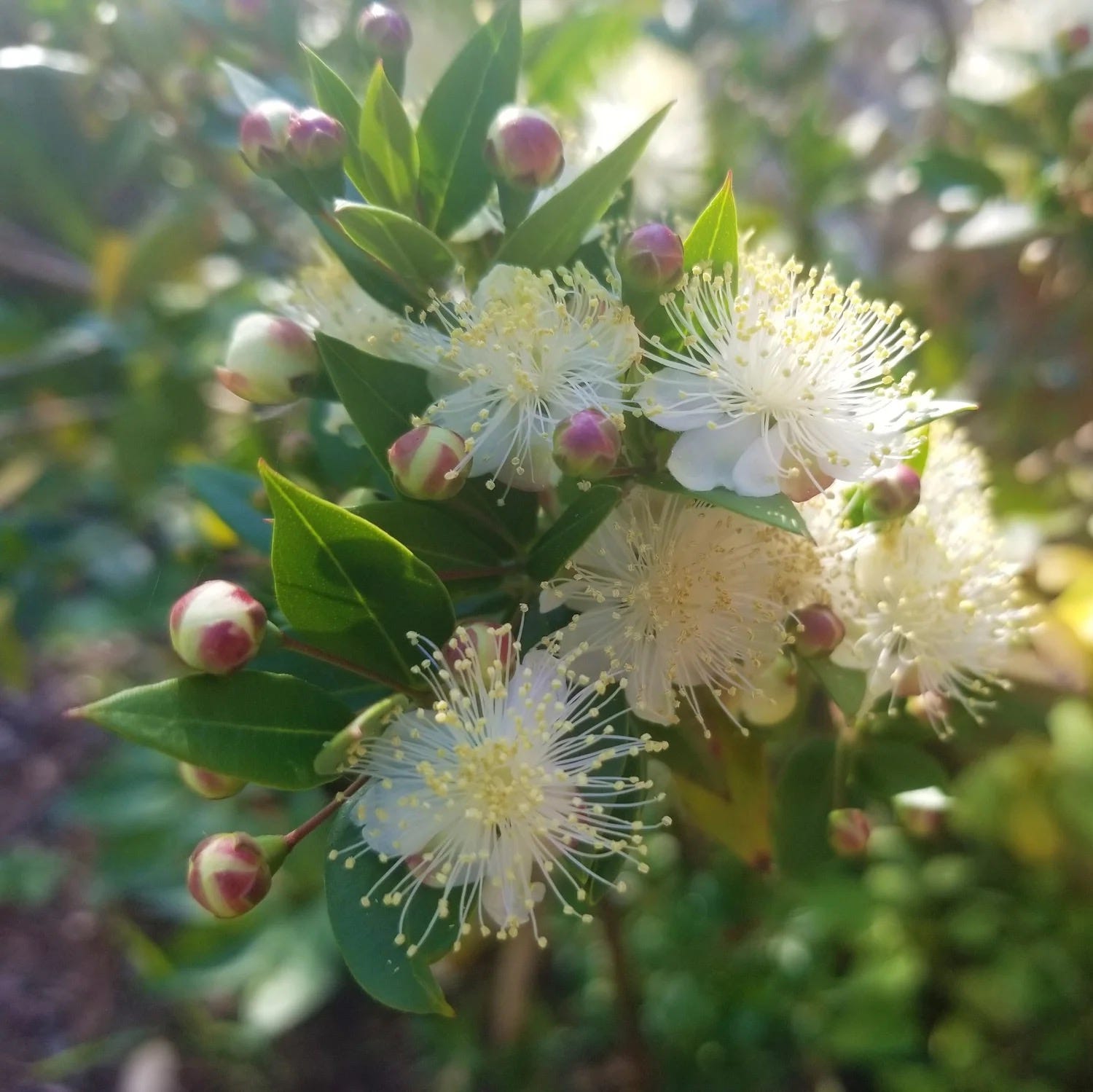
As a perfumer, all good stories start with my nose and following my intuition. Wandering down via della Colonna Antonina, I arrive at Profumum Roma, the Roman fragrance house, to do some exploring. Acqua di Sale, meaning salt water, is a blend of salt, seaweed, myrtle, with a base of one of my personal favorites, Virginia cedarwood. I’ll admit that scents that fall into the “marine” category have never been my thing; most of them turn strangely acrid on my skin within an hour, so I’ve been turned off at mere mention of “marine” for years. Acqua di Sale, though, doesn’t act this way at all. It opens with a sharp blast of a camphor-like aroma, mimicking the mist of the sea waves. That’s the myrtle and, for me, it does more work than a singular perfume note usually does. The Romans tied myrtle to Venus, who absorbed the famous Greek origin story of being born from sea foam. Fragrant Mediterranean coastal plants were bound up with water deities generally. Myrtle, a plant pulled straight from the rocky coastal scrubland where it actually grows, was used in ritual baths, including the Baths of Neptune in Ostia, not far from the city. This is a powerhouse of a perfume. Days later, the scent lingers, which feels on brand for a city that doesn’t believe in endings either.
Even though we have historical accounts of the city itself not smelling pleasant, personally smelling good was never incidental. It mattered socially as an invisible status symbol, proof that you had the leisure time and the means for the baths, even if it did cost little to nothing to enter. To wash, an olive oil base was used and infused with mainly herbs. If you were wealthy, rose, cinnamon and saffron were in the mix. The more exotic the scent, the higher your status in society.
Those baths, and the city of Rome itself, are really a celebratory story about water, because none of that scent culture would exist without the baths, and the baths wouldn’t have existed without what the Romans engineered to feed them. They called their own city Regina Aquarum, Queen of the Waters, and they weren’t being modest. Eleven aqueducts, built over five centuries starting in 312 BC, moved more than a billion liters of fresh water into the city every single day. Today, around 2,500 of the fountains, called nasoni for the nose-shaped curve of the spout, are still running on nearly every corner.
In the middle of an afternoon during a heatwave, there is no better feeling than hearing that sacred splashing sound and tasting the ice-cold water, drinking straight from a system whose foundations have served the city for two thousand years.
The god Neptune himself started here, not at the sea, but in that same freshwater story. Long before Rome had a navy, he was the god of springs, streams, and of the Tiber, worshipped for entirely practical reasons: an inland farming city needed its water managed and its droughts prevented. It wasn’t until the 4th or 3rd century BC, as Rome absorbed more of the Greek world, that Poseidon’s trident and dolphin and open sea were folded into Neptune’s mythology. The sea god Rome remembers now is actually the second half of the story.
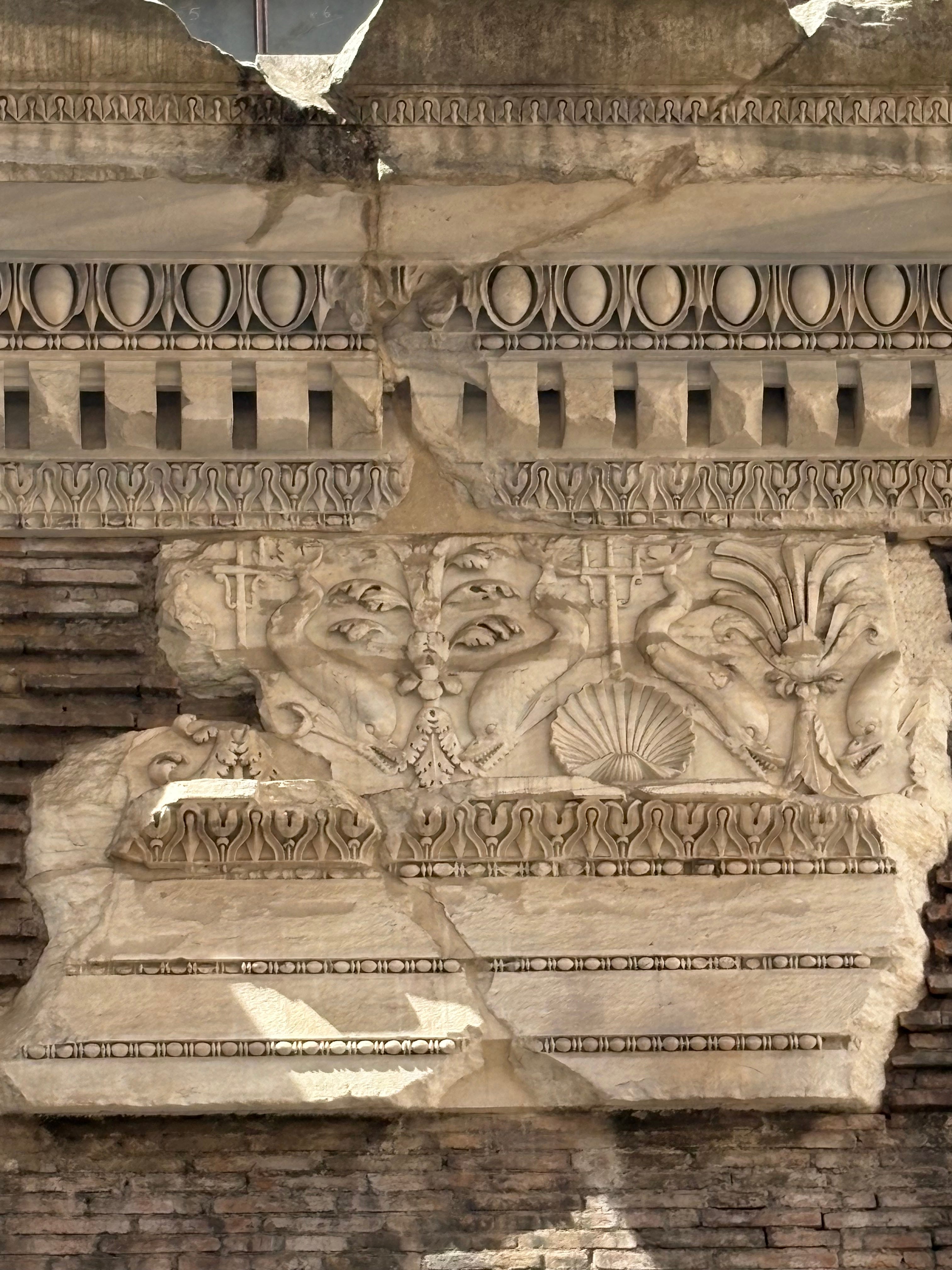
You can still see the first evidence of that second half if you know where to look. Behind the Pantheon, past the crowds snapping their obligatory selfies, there’s a stretch of brick arches that used to be the Basilica of Neptune. It was commissioned by Agrippa around 27-25 BC, part of the same building program as the Baths of Agrippa next door, and it was never a temple. Basilicas then, as we know them today, weren’t sacred houses for a god; they were civic halls for business and law. This basilica was decorated with dolphins and tridents and ship ornaments to celebrate Rome’s naval victories rather than to worship any god directly. It burned in 80 AD and then Hadrian rebuilt it.
Earlier this week when I stood there, it wasn’t tourists that gathered on the walls overlooking the arches. It was a handful of Glovo delivery riders on their break, scrolling their phones in the shade, water bottles beside them, likely refilled from the nasoni, perhaps completely unaware they were leaning against a two-thousand-year-old naval monument.
Neptune still hides in the basement of the department store Rinascente, where a section of the 12-mile-long subterranean aqueduct, Aqua Virgo, is still flowing. I went to see for myself, and they’ve done a good job preserving the original structure, even projecting a short video onto it about its history.


Fresh water is the city. It’s the aqueducts, the thousands of fountains still flowing and scattered around, the baths, the myrtle steeped in ritual water. It’s the part of Rome that never left home, the Tiber-fed, drought-averting, practical devotion that came first and asked for nothing more than survival.
Salt water is the empire. It’s the navy, the Mediterranean, the dolphins and tridents carved into a basilica behind the Pantheon built to commemorate victories won far from any river or springs. It’s Neptune after Rome went looking for more than it had, the part of the story that got grafted on once staying home stopped being enough, the part a Roman perfume house eventually bottled and simply called by its name.
I started this piece thinking I’d write about a perfume, but how can I when everything here is connected? Eleven aqueducts, one Venus-adjacent shrub, and a basement in a department store later, I’m still not sure this city actually has a bottom layer. I’m not sure I want it to. Neptunalia is in two weeks. I’d love to be at the sea, but most likely I’ll be standing somewhere near fountains.
What a beautiful, packed piece! This was perfect morning reading (thank you!) and felt like the kind that poured out of you and stand even need much editing because it just flowed. ♥️ I agree, Rome is a layer cake with way too much to keep learning. I’m glad to know people who can tech me too.
In other news, acqua di sale was, a few years ago, the “it scent.” It was everywhere on everyone. Like Baccarat Rouge. I tried it. It died on my skin. Then I discovered that Comptoir Sud had actually created the original (acqua Motu). Check it out. If you like AdS, you might LOVE AM.